Diagram or concept map about PDP
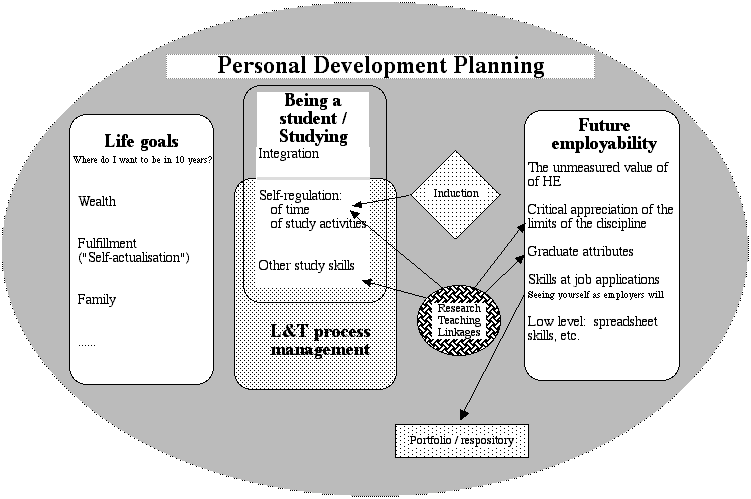
|
Diagram or concept map about Transition

|
Diagram or concept map about First year and induction

|
Indented list representation
Each topic below is comprised of, or at least overlaps strongly with, the topics shown as bullet points below it.
Personal Development Planning
The acronym and its meanings
PDP, the acronym, has 2 or 3 meanings:| PDP-1 | Personal Development Planning Personal Development Process |
Process | Learner centered | Education-led |
| PDP-2 | Personal Development Portfolio | Product | Teacher centered | Technology-led |
PDP-1 the process
Portfolios (PDP-2) are just an implementation to help one of 5 aspects of employability, which is only 1 aspect of PDP-1. Elsewhere I have some further notes on it.PDP-1 should end by connecting to LLL (lifelong learning).
- Life goals
- Wealth
- Fulfillment ("self-actualization")
- Family
- Being a student, studying
Managing what you want to learn and how you go about it.
- Integration
- LTP management; time management; self-regulation
- (Other) Study skills
- Future employability
(Some further notes.)
Levels of benefit from HE:
- The ultimate unmeasured value of HE
- A critical appreciation of the virtues and limitations of the discipline studied
- Graduate attributes e.g. critical thinking
- Making convincing job applications, based on accumulated evidence of the claims (assembling a PD portfolio).
- Low level employability features e.g. spreadsheet skills
LLL: lifelong learning
This is an aspiration that HE should turn out graduates capable of managing their own future learning, rather than leaving learners with a fixed stock of skills for the rest of their lives. It should probably be considered as an end point, or continuation of, PDP. There are two main sub-issues to consider:- CPD: continuing professional development. I.e. further HE training courses to update or extend knowledge.
- However Allen Tough has established that in reality, a majority of people are typically doing deliberate, intentional learning from ages 16-60 at least, and that the majority of this is done without the help of a teacher or course. In other words, LLL is and has been for many decades an unremarked fact of life. http://ieti.org/tough/learning/index.html
- Self-regulation (of learning)
- Autonomous learning
School-university transition
This is about whether an incoming student is ready for successful work as a university student with respect to:- Pre-requisite concepts. Tested by entrance qualifications, but this only works directly for subjects like Physics and English where the school and university versions are aligned. For subjects where there is no school version (or the school version has the same name but a different nature), then this can be a problem.
- Pre-requisite procedural skills e.g. essay writing.
- Self-management of work. On the whole, in HE the great majority of hours spent learning are done alone.
Transition is closely intertwined with:
- Induction, which is supposed to address at least some problems with transition.
- The first year experience, which is when induction and transition must occur.
- Widening participation, which means attracting non-traditional students and supporting them to succeed at university. Obviously transition is likely to be a considerably bigger problem for these students.
- Access courses which are specifically to address and overcome transition for some students.
Induction
"Induction" means the process of new arrivals becoming functional as students. The degenerate meaning is a single mass briefing session. So the first point is:It thus also overlaps with other themes and with other types of activity:
- PDP
- First year experience
- Assessment and feedback
- Retention
- Pastoral care
Activities / interventions
- First week projects (Some further notes.)
- Student generated PDP (Some further notes.)
- Access courses / Summer schools for non-traditional students (Information) (testimonials)
- Foundational academic experiences e.g. ...
- Establishing solo learning practices (not waiting to be supervised)
- Peer interaction on learning content
- Interaction with staff about learning (interaction, not just listening).
Related Themes
Film made for induction in 2009:
First year experience
First year experience refers generally to a focus on ensuring quality for students in their first year, partly to combat a tendency to spend the least time and attention on these "low level" courses; partly to launch them in good habits that will benefit them thereafter and which they may largely maintain without further special staff support. Elsewhere I have some further notes on it.It also overlaps with:
- Induction (Some further notes.)
- Transition from school to university (Some further notes.)
- Retention / drop-out (Some further notes.)
- PDP (See elsewhere on this page.)
Any of the activities listed under induction could be thought of as important for the first year and not necessarily badged as induction.
Research-Teaching linkages
The tacit question behind this theme is: why academics should be paid for research, when their obvious social function is teaching? In addressing this by collecting case studies of where such linkage is beneficial for learning, and hence articulating the various possible links between research and teaching, some useful connections emerged between RTlinkages and:- PDP
- Graduate Attributes
- Employability
- The first year experience. Most staff think it is too hard to connect teaching and research in the first year, yet some striking cases can be found even of this.
Retention / Student dropout
- The biggest factor affecting the dropout rate is the degree of selection applied to those admitted to a course. This means it is fundamentally mistaken to discuss retention without simultaneously addressing the issue of entry standards and widening participation (non-traditional students). It may be possible to improve both together (e.g. by running Access courses), but not by addressing one without considering the other at the same time.
- I have notes on theories of dropout (such as Tinto's) here, here, here, and a diagram / concept map here.
- However theory and effective practice scarcely overlap. Another angle is to look only at practical interventions for which there is at least some evidence of effectiveness (a much smaller list) here.
Assessment and feedback
"Integrative assessment" was an enhancement theme, resulting in 4 reports by Dai Hounsell. reportsA much larger project on A&F (assessment and feedback) was the REAP project, which demonstrated learning gains simultaneously with cost reductions through redesigning aspects of A&F on a number of courses.
Points that could be relevant here are:
- An aspiration for A&F which is widely subscribed to, though not (yet?) closely connected with practical interventions of demonstrated value, is to promote and increase the self-regulation of learners. I.e. to move them towards lifelong learning, to be able to judge their own work and manage their own learning with progressively less management for teachers.
- An adequate approach to induction must include feedback to the newcomer on their work: how well they are doing in the first weeks. Traditional university ideas of assessment are to do with measuring accomplished learning when it is finished. A&F in first year must be reviewed and perhaps substantially redesigned to serve the function of induction and the needs of new students.
- Feedback is usually considered only as a way of correcting the technical skill and knowledge of learners. Analysis of how students actually use feedback suggests this may be only one of several functions, a more important one being the self-regulation of effort (i.e. whether to work harder on a topic, or reallocate effort to another task). In general A&F may need to be redesigned to serve the other equally important needs. This argument is sketched in: "What are learners actually regulating when given feedback?".
Graduate Attributes
The idea here is to articulate a set of properties which HE graduates have, or should have, regardless of the discipline they studied. The problem with this is that by looking for such lists, you have to ignore or even deny the fundamental organising principle of HE which is that you study one discipline, and that this moulds your thinking in an importantly different way from other disciplines. Here is such a list.It may be helpful to contextualise the notion as representing a middle level of desirable employability attributes as listed in a diagram on this page, and here.
Pastoral care
This is not currently fashionable, but is probably a good candidate theme. Staff worry about this, but there is no systematic provision. It is however questionable whether there should be. There are a large number of support services and student-led services, without overt coordination, but probably with effective implicit coordination in that they know about each other and cross-refer when appropriate. Furthermore students often seek help from other students. A few universities have explicit mentoring schemes, and these may reduce distress and dropout by pre-establishing a useful contact to whom a student in trouble will go first.Aspects of thinking about this include:
- Peer mentoring (some further notes on it.)
- Teacher monitoring: one staff member who keeps track of a student's performance on all their courses. (some further notes on it.)
- Student support services
The general nature of "new" initiatives
Shorter summary: 3 actions
For each "new" issue, check whether:- New name, but no new substantive issue. Find out what it used to be called.
- New name, but the function has already been effectively provided for a long time. Find out how it has been implicitly addressed up to now.
- Learners will have found their own ways of dealing with the issue. Much does not depend upon the staff. Find out how learners deal with it without staff help.
Summary
- Little if anything is new in education apart from changing fashions in
labels (jargon). The first job then is to identify what old term the new one
corresponds to, or most overlaps with. That is the aim of this page and the
diagrams.
MAYES, J. T. (1995) "Learning technology and groundhog day" in: V. B. S. W. STRANG & D. SLATER (Eds) Hypermedia at Work: practice and theory in higher education (Canterbury , University of Kent Press) - HE has functioned without the new term new initiative for a long time without collapsing. The 2nd task is to identify how this has been possible: what aspects of old practice have in fact been addressing the "new" issue all along.
- Thirdly, find out what learners are already doing about this without any help from staff.
- The thoughtless response to a "new" issue, or new initiative is to presuppose that a new activity must be created that staff design and deliver "for" students as an external sign to represent the concept. This is to presuppose that all previous staff were too stupid to have thought of it, and that all students are too helpless to have done it for themselves. This is a dubious approach for infants, and is seriously inappropriate in HE where the aim is to produce independent, self-managing learners. (It does however create an appearance of new action by staff and management.)
- The more difficult but more intelligent approach is to identify
activities that simultaneously advance as many "issues" as possible: this is
the sign of good educational design.
For example a bad approach is to "do" induction by bringing in a speaker whom the students have never seen before and will never seen again; then "do" social integration by organising a party or reception; then "do" starting the course by a series of lectures, and follow that by a project applying what has been taught. This is a logical planning approach, where the events represent the thoughts and categories in the designer's mind. A more intelligent approach is start on day one with group projects. There is no artificial pretext for introducing students to each other: social bonding follows a joint task not vice versa. There is no lecturing in the abstract with no connection to action. They find out what they need to know by encountering problems, and in a small group context they can ask. etc.
Implementation by academics
Most academics just express bewilderment (followed by antipathy) when asked to act on these topics. However a few basic points are important to realise, and go a long way to making it more practicable.- These topics or initiatives overlap, in many cases by a great amount. The first and most important step is to recognise this overlap: the concept map on this page is a start in addressing this.
- It follows that many features of teaching address several of these issues at once, and should be used as "replies" to several. It may be regrettable that these initiatives do not themselves acknowledge these connections. However for practical action, the first step is to work out the overlaps, and realise that it is quite easy to make each concrete action address multiple "issues".
- For all these issues, past and current courses and programmes already address these issues in important ways: re-labelling when dealing with reports on the issues is all that is needed. Instead of assuming that a new initiative with a new buzz word requires new action, review what teachers are already doing that in fact implicitly but substantially addresses the "new" issue.
- Likewise, review what learners are already doing that in fact implicitly but substantially addresses the "new" issue.
- The main defect in most departments' approach to these issues is not the complete absence of good practice, but failing to review and deliver provision over the degree programme as a whole. Integrated review over all years, and adjusting provision as necessary.
- Easy access to case studies of good practice, preferably in EVERY discipline, is useful, and may well be enough to support addressing each issue fully.
- Avoiding the fallacy, which many academics fall into, of presupposing that a rigid course structure is necessary that provides teaching for the issue at just one time. This is important for normal subject teaching, perhaps especially in science, because later courses often rely on students having mastered material in earlier courses. But this does not apply to these issues of personal development, preparation for work, etc. On the contrary, they are only likely to have any impact on students if done when the individual student is ready to be interested in them, and find them relevant. Thus the default approach, instead of being scheduled rigidly for just one semester within the degree, should be that the student must complete them before graduation but can do them when they think best.
Roadmap for academics
Unless you think that these issues can all be implemented without much connection to existing courses e.g. by separate, centrally delivered, activities -- and a lot of evidence is against this -- then these issues need to be taken on by regular, discipline-based academic staff. The thing ordinary staff most need is a way of understanding how these issues relate to each other, and to the main considerations underpinning course and degree programme design currently: let's call it a "roadmap". There are two reasons this is needed.Firstly, to translate the terms into language that is understood in the discipline. One big part of the issue is that the educational and administrative literatures naturally have their own terminology, but it is not standard English and has no clear meaning for other staff. The other, is to help academics recognise what it is in their own standard practice that in fact currently supports each of the new issues already.
Secondly, these issues all interact, and are to some degree in conflict. Consequently no rational and responsible course designer or course team leader can pay any attention to a "new" issue like retention or employability without also first knowing a) what other issues it interacts with, and b) what should be done worse in order to do better on the new issue. This is a standard design tradeoff situation. It does not mean that it is a zero sum game where you must lose as much under one heading as you gain under another: on the contrary, good design is about optimising compromises. But almost always, you will do less well under each heading than you would if that alone was your sole concern. For instance, if you want to improve retention regardless of anything else, then much the best move is to reduce or eliminate "widening participation"; but if you want to do well on both, then intelligent design can probably improve your score at the worse of the two, while reducing your score on the other only a bit. One of the things you may do worse on is holding down costs: to achieve everything you used to plus something more may be possible if more resources are spent on it. Since one important resource is student time, it may mean lengthening courses or increasing student debt because they cannot work so many hours of part time paid employment. However far too much of the literature, and of policy and strategy documents, fail to acknowledge these basic realities. This makes them fundamentally unrealistic and so irrational; and consequently to be resisted by anyone who takes their responsibilities to students seriously.
What is needed then is:
- To list all the "new" factors and their inter-relationships,
- But then also list (make explicit) the "old" factors i.e. the academic values underlying each discipline's degree programmes, and their inter-relationships with all other factors.
- Give an order of priority for all of these.
- A discussion for each factor of what you might do if it were the top or sole priority: this can help to make clear ideal tactics, what would be sacrificed if they were used, and generally clarify the earlier points.
ToDo

Technical
How to get larger scale pictures ...
	Can't because can't spec. size of an HREF

How to get high-res pictures ...

Get php-exec-wtable to work
Find a way to show the indented list twice: w/w/o explanations.

Image map to be installed?

PHP word count:
	Do in in PHP not unix callout
	do commas, rounding in nmb fmt
	Better if could do it on page after PHP expansion?