Last major change
25 Feb 2008 (9 Sept 2023)
Format edits 29 July 2023
............... Length about 8,000 words (56,000 bytes).
(Major first draft completed 7 May 2003.)
This is a WWW document maintained by
Steve Draper, installed at http://www.psy.gla.ac.uk/~steve/localed/tinto.html.
You may copy it.
How to refer to it.
Web site logical path:
[www.psy.gla.ac.uk]
[~steve]
[localed]
[dropout]
[this page]
Go over papers for method criticism
Pursue wider lit. e.g. via Lynn chapter.
*Find measures used by others
By
Stephen W. Draper,
Department of Psychology,
University of Glasgow.
These notes are a very personal view, not well researched, and possibly
severely flawed.
The first topic is what determines whether students stay on or drop out at
universities. Various terms may reasonably be used for this area. The
negative-looking ones are failure, dropout, attrition; the positive-looking
ones are retention, persistence.
Tinto offers a theory for understanding this. Elsewhere I also have some
notes on
basic
comparative dropout rates.
The follow-on topic is about the school-university transition. In it I argue
that this is in fact a sub-part of the Tinto issue.
Some other pointers related to Tinto are on
another page
including surveys related to dropouts at this university, a review of the
literature related to Tinto, and a variety of diagrams expressing Tinto's
theory.
The most commonly referred to model in the student retention/dropout
literature is Tinto's. It was first offered in a literature review (Tinto,
1975), and so began with the support of being broadly consistent with a
considerable range of other people's research, as well as having a theoretical
derivation by analogy to
Durkheim's model of suicide (1897 / 1952).
It probably gains most support though because it immediately appeals to
people's commonsense with its central notion of "integration". It is less
clear whether there is much direct empirical support for it, and certainly it
is hard to find direct empirical tests of and challenges to it. The
literature claiming to support it seems to be about reporting weakly
consistent evidence: not controlled experiments, nor comparing alternative
theories against Tinto's with respect to data.
|
|
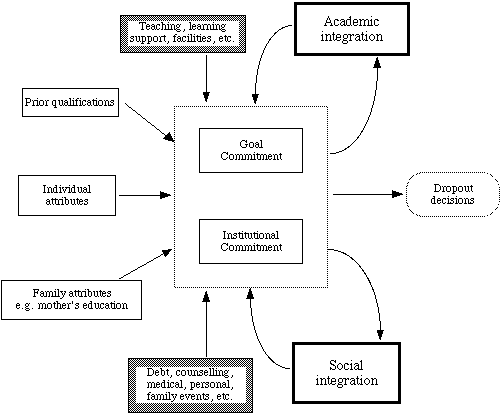
This is adapted by me from
Tinto,V. (1975) "Dropout from Higher Education: A Theoretical Synthesis of
Recent Research" Review of Educational Research vol.45, pp.89-125.
|
Its central idea is that of "integration": it claims that whether a student
persists or drops out is quite strongly predicted by their degree of academic
integration, and social integration. These evolve over time, as integration
and commitment interact, with dropouts depending on commitment at the time of
the decision. A first pass might perhaps try to measure these by:
- Academic integration
- Grade / mark performance
- Personal development -- or does this just mean a student's private
judgement on the value of what they are learning (as opposed to official marks
/ teachers' judgements).
- "Do you think you are doing well academically?" (Academic self-esteem)
- Enjoying your subject(s).
- Enjoying studying your subject(s): i.e. the study patterns
required/requested are or are not enjoyable.
- Identification with academic norms and values
- Identification with one's role as a student
- Social integration
- How many friends you have. It probably doesn't matter whether you fit
with the dominant social crowd, only whether or not you have a group of
friends you fit with.
- Personal contact with academics. In fact, it may be that it is important
to measure really small amounts of contact: how many staff know your name,
smile at you, ... ("How many staff have you had a personal interaction with,
however small?" "How many personal interactions with staff have you had this
year?").
- "Are you enjoying being at university?"
Tinto was keen for studies to measure / distinguish different
reasons for departure: being thrown out for failing exams vs. voluntary leaving.
In reality there is a middle category where you can't tell if students are
marked fail because they stopped attending (voluntary but didn't tell the
university), or did badly and although not told they must leave this removed
their commitment and they then decided to leave.
Such papers seldom report the actual questionnaire items used to
operationalise the theory. This means that they may not test the theory at
all, but the reader cannot know this. For instance Borglum & Kubala (2000)
seem to have used a questionnaire designed for a quite different purpose,
simply measuring student satisfaction with the college, yet assumed that all
items could be classified post hoc as measuring a Tinto-related variable.
More perniciously, by never discussing the design of questionnaire items,
major theoretical issues are ignored. For instance does "social integration"
mean integration within that institution, or generally? Probably Tinto meant
the former. Yet a student with no friends anywhere, and a student with plenty
of friends who however are not enrolled at the same college are likely to show
different tendencies to dropout. Scrutiny and discussion of individual
questionnaire items is a good way to identify theoretical issues, and
conversely eschewing such discussion furthermore makes it likely that no two
studies are measuring the same thing, yet are unable to determine this.
Need 100% samples especially of the dropouts: any less, and self-selection
must be likely to distort it by losing those ashamed in some way (or leave
only those with the most distorted rationalisations).
Furthermore, face to face as opposed to paper instruments (i.e. interviews not
postal questionnaires) may be very important for quality all round. Certainly
comparing face to face persisters with paper dropouts could be bad.
Even then, it will be like interviewing people about their divorces:
everyone will have a story, but it is a story they can live with, scarcely a
dispassionate account.
Rationalisation by each student, particularly dropouts, may mean that what
they say about causes is not useful. They will be very likely to describe the
cause as external factors (the classic Social Psychology attribution error?).
So for this, should attend only to data on external factors, and get it
equally for persisters. In fact the Brown and Harris method of collecting
descriptions of external factors for all, and getting a panel of experts to
rate their seriousness "blindly", may be essential.
Similarly for "internal" and all "ask them" measures of attitude, Tinto
integration etc.: we should ask all students before as well as after external
events, and before exam results, and before dropouts. I.e. do prospective
studies.
SO:
- Prospective studies, with measures (especially subjective/internal ones)
taken before (as well as after) dropout events such as failing exams, and
collecting these measures for both persisters and dropouts.
- For external events (always collected retrospectively), collect these for
both persisters and dropouts.
- Get a panel to assess the seriousness of external events; don't trust
subjective assessment. (And hence, don't use dropouts' own opinion on why they
dropped out.)
- Must get 100% or random samples especially of dropouts (not self-selected
samples).
The literature to date seems not to provide strong proof or even good tests of
the theory. However to do so would require a large programme of research with
multiple methods, particularly to address the extensions to Tinto's model
discussed below. The simplest approach is to generate large questionnaires,
with items relating to parts of the model, and use correlations. The trouble
with this is that it implicitly treats all factors as independent and as
adding linearly. Thus it fails to test the structure of the model, and
similarly cannot deal with quite simple aspects. For instance consider
vitamins: eating more of one vitamin does not compensate for having too little
of another; and furthermore, if most subjects have enough of one vitamin,
correlations will be low and tell you as much about the population as they do
about the importance of the factor. Techniques such as path analysis, and
structural equation model testing try to addrss this to some extent, but
probably not sufficiently. It seems extremely likely that learning is
determined in some places by conjunctions like vitamins: a learner has to have
all of a set of factors, and will fail if any one is deficient (e.g. must have
both motivation and adequate study skills and adequate learning
resources). In other places it is probably determined by disjunctions: a
learner may either learn from lectures or from textbooks, but may well need
only one of these alternatives to work well for them.
At the opposite end of a spectrum from statistical treatment of multiple
factors at once, would be case studies: looking for cases where a particular
feature of the model is crucial, for instance personal staff contact as
essential for adequate "social integration" which in turn is an important
pre-requisite for whether nor not a student seeks help when they need it.
Slightly beyond case studies might be surveys measuring just this factor
every 2 weeks (say), then when a jump is seen in an individual's measure on
this, following up with an interview to identify what critical incident caused
this shift. Such an approach might both operationalise and establish parts of
the overall model, piece by piece.
Recently a different sociological approach claiming to be a rival has
appeared (Braxton; 2002). A key phrase is "social capital" (see also in the
Liz Thomas section below). However, perhaps we could see this as a part of
what is implied in Tinto's model, but with more emphasis on integration
between the student and social groups (and forces) outside the university.
Another notion is Bordieu's "habitus", which Thomas (2002b) explicates as
"the norms and practices of particular social classes or groups".
For me, the issue this indicates can be construed as to do with how the
role of student has aspects to do with fitting the academic institution, with
fellow students, and with external social groups and their views of the
place and value of students.
What follows is my proposed extension of Tinto or synthesis of Tinto's
original model with additional concepts.
A further development of the concept(s) might expand the notion of
"integration" in the following way. Firstly, consider it as a measure of
fitting the role of student. Does the student feel that they fit happily into
the role of student? Fit has two aspects: internally, do they feel it fits
them from a personal perspective, and externally, do they feel happy in how
others view them in this role. Fitting is about any causes of friction or
dissonance, even those too slight to be consciously noticed and spoken about.
We can see the role as having two major aspects, academic and social. The
academic is about learning, and the activities necessary for that. The social
is about fit with the groups the student cares about, both inside and outside
the university. A person who identifies totally with being a student will care
only about their place with other students, ignoring the values of any outside
groups; someone who comes from a family that expects a university
qualification will probably make friends in the university but also expect
family and employers to regard being a university student as an expected and
worthwhile stage in life; but someone from a family or group unused to
university may have trouble with the mismatch between being a student and
markers of respect such as a job, current income, an expensive car, children
of one's own, etc.
Another dimension is to distinguish goals, methods, and effectiveness or
achievement. Clearly a person may love an objective but dislike some
method necessary to achieving it: may like writing essays but be bored by the
preparatory reading (or vice versa), just as someone may love tropical holidays
but be afraid of flying to get there. Treating the achievement as distinct
from the goal is in a way redundant, but provides an opportunity to examine
the gaps there can be -- for instance due to the problems of assessment --
between the measures used and the aims they are supposed to assess, and also
between a student's aims and their actual achievement. A person can sometimes
feel they love a subject and yet be hopeless at learning it. Another reason
(for looking at both goals and achievement) is that a person may not have
thought much about a goal, yet on failing to achieve it they feel a problem
e.g. not getting on with staff or fellow students may not have been an aim one
way or the other, but can subsequently be felt as a problem anyway.
The third distinction, between internal / external aspects of fit, comes from
the standard distinction between intrinsic and extrinsic motivations for
learning: whether you do it for personal reasons (interest, enjoyment,
curiosity, "for its own sake"), or for extrinsic reasons (means to another end,
to get the qualification, to be admired, ...). But in principle this can be
applied not just to the motivation (the goal), but to activities/methods and
results. For each activity may have some positive or negative inherent
value for an individual apart from the goal, and this may be for intrinsic or
extrinsic reasons. For instance asking questions in class might draw dislike
from other students (extrinsic negative value), but be useful for the
individual in checking whether they have understood (a standard personal
learning technique with positive intrinsic value).
In general, for methods and intrinsic/extrinsic, we should ask a) are there
any things others (staff or students) require of you but you hate (or love);
e.g. tutorials make you nervous, computer use is compulsory, hours in the lab
are tedious.
b) are there any things (learning methods) that you require or find important
for your learning, but which others obstruct; e.g. you need to ask questions
(but there's not time); you want time to think, but the lecture always rushes
on; you want to discuss an idea, but everyone has to leave and there is no
place or time to do it.
Putting these together, we have [A] three fields for integration: academic, and
social inside and outside the university. Fit (or conflict or dissonance) [B]
might be divided into arising from goals (or wishes, or desires), from
methods (or skills or capabilities or habits), and from effectiveness (or
measurable achievement). And [C] there are always two aspects of fit: with
the individual's own internal self, and with external demands on them.
Multiplying these together would give us the set of questions and
issues below: {Academic, social within university, social outwith the
university} X {Goal, method, effectiveness} X {Intrinsic, extrinsic}.
(I shall interpret the combination of methods with intrinsic/extrinsic as
follows.
Method-intrinsic: deals with the student's own existing methods and asks the
question: are they allowed/used or obstructed /not useful. Method-extrinsic:
deals with the methods / activities externally required by the course, and
asks the question: does the student like or hate them, are they good or useless
at them?)
For each resulting element I indicate one or more draft phrasings for a
corresponding questionnaire item. These items may be in an open-ended form
(asking the participant to tell us if there's anything that might be an issue
in this category), or sometimes specific where experience suggests examples of
specific things that have been a problem for some students. Additionally, for
some I indicate a remedial intervention (abbreviated below to "fix") that
might be tried if the aspect seemed a particular problem in a given context.
Words in [square brackets] are pointers to other theoretical concepts.
Here is how the dimensions play out into parts, each with a draft questionnaire
item.
- Academic integration
(We should ask all of these repeatedly for each course a
student is doing. Feeling unhappy with just one of the three courses a first
year student takes is often sufficient for some to drop out, just as anyone of
principle will resign from a job that violates a single one of their ethical
principles.)
"How are you getting on with your studies? What is the worst thing about it?"
- Goals.
"What are your reasons for studying?"
- Fit with intrinsic goals
"Do you enjoy what you are studying?"; "Is the subject interesting?"
- Fit with extrinsic goals
"Is what you are studying useful?"
"Is what you are studying leading to the job or career you want?"
"Is getting a (good) degree (grade) important to you?"
- Methods.
"Is studying the subject like you expected it to be? What are the differences?"
"What difficulties do you have in learning on this course?"
[Breen]
Fix: Put them off before they come and sign up to a course they don't like.
- Fit with intrinsic/existing skills and aptitudes.
"Does the course exercise things you like to do? e.g. problem solving, showing
skill in essay writing, ..."
"Are there any things (learning methods) that you require or find important
for your learning, but which they obstruct; e.g. You need to ask questions
(but there's not time); you want time to think but the lecture always rushes on;
you want to discuss an idea, but everyone has to leave and there is no place
or time to do it."
- Fit with extrinsic/demanded skills and aptitudes.
"Does the course demand kinds of study and work you like or dislike or have
trouble with?
e.g. maths, long lab hours, ....writing, ...?".
E.g. tutorials make you nervous, computer use is compulsory, hours in the lab
are tedious. Writing long essays whose structure you have to invent (rather
than many small exercises).
"Are you able to participate in seminars, or are you too shy?"
"Can you take effective notes in lectures, or don't you have the skill?"
Fix: Introductory courses, summer schools, before
entry, study skills support / teaching.
- Effectiveness.
[Snyder's Hidden curriculum]
"Are you learning as much as you want?"
- Achieving intrinsic goals
"Do you feel you understand the material by your own standards?"
- Achieving extrinsic goals
"Are you getting good enough marks?"
- Social integration within the university
"Do you feel comfortable being a student at this university?"
- Goals.
"Do you want to get to know a) staff or b) students and if so why?"
- Fit with intrinsic goals
"Do you like being part of the university, or do you think it's a worthless
institution (apart from giving you a qualification)?"
"Do you want to get to know other students, or aren't they worth knowing?"
- Fit with extrinsic goals
"Do you think that getting to know staff and students is useful to you?"
- Methods.
"What are the good and bad things about the ways for getting to know staff and
students you find here?"
- Fit with intrinsic/existing skills and aptitudes.
"Does student life go with your preferred kinds of socialising (e.g. clubbing,
hill walking, dinner parties, ....)."
"Does the kind of chat you like to have go down well with students and
staff?"
Fix: "Peer assisted learning" i.e. mentoring by students a year or two ahead.
- Fit with extrinsic/demanded skills and aptitudes.
"Do you know how to make friends with other students?"
"Do you know how to talk to other students?"
"Do you enjoy the social activities other students propose?"
"Is the kind of chat you find yourself having with other students or staff
enoyable or not?"
- Effectiveness.
"Do you feel comfortable around campus, the department, in lectures, etc.?"
- Achieving intrinsic goals
"Have you made as many friends as you want?"
"Are you able to get the kind of conversations you would like?"
"How many staff have you had a personal interaction (however brief) with?"
["Empathy" in Bridget Cooper's sense]
"How many other students do you know?"
Fix: Field trips, reading parties, tutorials, advisors, office hours meetings
with staff
- Achieving extrinsic goals
"Do you feel able to ask staff questions when you need to or want to?"
"Do you feel you fit in with other students in the class? in the university?"
"Do you have a problem collaborating in group work as required?"
- Social integration outside the university
"Does having been to this University fit with the kind of person you want to be?"
"Do you feel comfortable being a student in the UK today?"
- Goals.
"Do you want to get on with people outside Uni, and for what reasons?"
- Fit with intrinsic goals
"When you're with people outside the university, do you feel proud or
embarrassed that you are a student?"
"Does being a student make you feel better or worse about yourself than if you
were doing something else?"
- Fit with extrinsic goals
"Will going to university and being a student be good or bad for you in
getting on with people outside the university e.g. family, friends,
employers?"
- Methods.
"What are the good and bad things about presenting yourself to outsiders as
someone from this university?"
- Fit with intrinsic/existing skills and aptitudes.
"My family constantly nag me to come home in the vacations whereas I find it
important to stay near the University to catch up on work"
- Fit with extrinsic/demanded skills and aptitudes.
"I want to get a degree, but my family want me to earn money for them."
- Effectiveness.
"Do you feel comfortable telling others you go to this University?"
- Achieving intrinsic goals
"Does, or will, going to University make you fit better into your life outside the
Uni.? More the sort of person you see yourself as being?"
- Achieving extrinsic goals
"Do you expect to get the recognition from others outside the University
that you want?"
"Is being at this university impressive to others?"
Goal - strategy - but also opportunities.
Does "integrated" mean:
- Comfortable
- Identified with the role
- Identified with our (expert, teacher's) view of the role i.e. not
with their misguided view of a student's role. At least for
academic-integration this seems important, as a considerable cause of dropouts
can be misunderstanding the role of a student. If so, then don't ask students
what THEY feel about integration, but ask them for indicators about whether
they are integrated in OUR view.
Does social integration mean:
- Social identity theory
- What a student needs to get collaboration with peers over learning e.g. to
borrow lecture notes.
There aren't just 3 points on the dimension of {Goal, method, effectiveness}.
Instead there are at least 5 points, maybe an arbitrary number. If so then
should multiply out the schema above by 5 not 3 points. The basic idea is
that some goals correspond to large external motivations, others are simply
means to an end serving larger goals. And similarly, a large method like a
lecture requires component skills from the student to benefit from it much.
My suggestion for an expanded dimension might be:
- Goal
- Subgoal e.g. learning statistics as a subgoal of learning another topic.
Learning to touch type as a subgoal of the whole course. Learning mind
mapping as a study technique for the whole course.
- Large scale M-acts e.g. seminars, tutorials, lectures
- Small scale M-acts e.g. bringing a personal agenda to each tutorial;
reviewing notes after every lecture; ...
- Effectiveness
Similarly, perhaps should split the goal and method points above and
multiply all by {(don't know), Know, can do, fit/like}.
As well as asking questions that presuppose they KNOW what is needed for
methods (say), we should test this assumption by questions about whether they
know what is needed. That is, do they HAVE:
- The ability to judge success and their own understanding (under
"effectiveness").
- Do they have the right subgoals e.g. realise they should learn new
note-taking skills etc.
- Do they even know the methods needed e.g. the time spent, when to spend
it, how to get benefit from tutorials, seminars, other students, ...
I.e. it is not only fit between the students' methods and the required
methods, but also the issue of knowledge of what method is needed, and then
possession of that method.
Thomas (2002a) suggests 5, not 2 or 3, types of integration / spheres.
- Academic
- Social: peer interaction and mutual support
- Economic. Hence university support services for bursaries, scholarships
etc.
- "Support" meaning counselling services.
- Democratic: students's union, student representatives on various
institutional bodies.
What do I think of this? well it is true that all of these have typical
university structures associated with them, so if I want to explain the LTP
perhaps I do need to expand to cover them? On the other hand, they are
probably important to dropouts, but maybe not otherwise to learning.
She is interested in a) dropouts b) "widening access" i.e. getting and
retaining a wider set of types of student. And argues with evidence that
maximising these means attending more to all 5 spheres.
She uses, and partly explains, the notion of social capital.
(Her paper gives some explanation of the concept and a number of references
such as Shuller & Bamford (2000).) But perhaps it actually isn't necessary
except broadly to think of this broader set of spheres, and the general idea
(already in Tinto) that weakness for a student in one can be compensated by
strengths in others. But in fact maybe her data (Thomas; 2002b) really partly
goes against this: i.e. she found that money wasn't an important reason for
persistence or dropout, and so isn't the same kind of predictor as, say,
social integration.
Social capital (seems to) mean: prior acquisition of contacts substitutes to
some extent for present knowledge. This is both learning but also actually
connection to people/resources i.e. not just internal learning but connection.
Actually consistent with Unix expertise: you can substitute knowing how to
learn for already having learned; and consistent with socially distributed
knowledge. I don't know if the metaphor of capital helps; but it is in another
way a smple extension of the idea of pre-requisites from facts and skills in
the chosen topic to other things.
So what do I take from it?
a) To predict dropouts, we may need all 5 spheres.
b) And they are all definitely about integration (e.g. economic: learning to
live on that amount, and this is eased by living with others with the same
constraints).
c) "Capital" does signal the advantage of pre-adaptation or prior preparation,
and how it can be traded on to solve new problems rather than be the
pre-solution.
d) And how it is not just about individual knowledge so much as working
contacts: having access to the socially distributed resources important to
being a student.
I'm dubious because:
a) The support and democratic spheres don't seem to affect all or even most
students; but the others do. The capital metaphor may help in understanding
the preconditions for these spheres too to work well; but I don't believe they
are so important?
b) The economic sphere affects all students; yet her research apparently
suggests it isn't as important in determining dropouts. So Tinto was right
after all? focus on academic and social spheres.
There are really three possible views of this:
- Thomas is right, there are 5 spheres needed to explain retention, and all
are equally important, with strong integration in some allowing weaknesses
in others not to cause dropout.
- Tinto is right, 2 spheres are key, the other 3 only affect some students.
- Tinto points to the key 2 spheres; 2 others are in fact really
subdivisions of his. "Support" sphere is really an occasional substitute for
friends i.e. a subsphere of "social". "Democratic" again is just a form a few
students use for peer and staff interaction. Campaigning is an alternative to
going for a beer with friends, and in fact likely to lead to deeper
interaction than most bars do. As for money, while it applies to all
students, it also applies to all non-students too, and so is no more a
specific predictor of dropouts than avoiding car accidents, keeping your liver
healthy etc.
This section is to collect and list educational interventions that can be
explained by Tinto-like theories (but often not by other theories). They may
also be designed to increase poor scores on some Tinto-related variable e.g.
"integration".
This is a crucial section because:
- Main point for me of exploring Tinto is to explain these mathemagenic
activities that are often put on at some cost by HEIs but don't fit in the
Laurillard model.
- Can I think of any new interventions?
Summer schools: to widen participation by increasing integration for targeted
groups in advance.
The whole business of school qualifications as preparation for HE.
Commonsense says that this is about knowledge pre-requisites: knowing facts
and skills that will be necessary and presupposed at university. However it
may really be a case of "pre-integration": of giving students previous
experience of what the subject mattter, and its associated study patterns,
feels like so that they can make an informed choice about what university
course they may like and be competent at. A relevant study would be to
measure prior conceptions of both subject matter, higher education,
jobs, ... etc. as tacitly creating a pre-integration level.
Field trips
Reading parties
Cheese and wine welcome parties
So called peer assisted learning (PAL) or supplemental instruction:
student-student mentoring.
Personal staff-student contact; "Empathy".
Tutor assignments and contacts.
Advisor assignments and contacts.
Feedback: summative assessment information to tell students that they "are" a
Geographer or whatever. Rank in the class?
Summer scholarship / working in a staff member's lab.
Groupwork (i.e. organised and made compulsory by the course).
Study groups (i.e. student-only peer groups).
Amount of discussing in L-acts (class, seminars, ...) BOTH personal
contributions AND seeing what others think.
There are other units and services, widely funded by universities, to do
with student support, and presumably likely to reduce dropouts. Implied by
Thomas' expanded list of spheres of integration.
Finance: bursaries, scholarships, hardship funds, etc.
Support services e.g. counselling, health
Students' unions. Student representation on committees etc.
What do they need to be or include?
- Staff "empathy" i.e. a bit of the personal tutor idea.
- Get students working together (social integration)
- But also, working together on subject content. This is good for
study skills, good for personal work-useful skills. And gets some content
discussion going which we suspect seldom happens in HE. And good for
learning. And good for academic integration.
- More feedback on learning. Actually formative, though at an
acad-integration level; though may seem to be summative in technical form.
That is: it should tell them how well they are really doing (rather than
correct detailed task performance), and so allow them to self-regulate their
effort rather than help to correct some specific task or skill such as essay
writing. This could be related to Snyder i.e. self-assessment,
and also with rank in class,
on several different types of measure (shallow MCQ, deep essay, feeling of
understanding). Note that in PBL (problem-based learning) students often
complain that the staff don't tell them how they are doing yet they enjoy it.
This could be that working in groups gives them good and frequent feedback on
how well they understand the material as compared to fellow students, and as
judged by how well they can contribute to their group, even though it doesn't
directly tell them how well they will do in exams.
How do such theories fit with anything?
I really want to integrate Tinto and the Laurillard model of the
learning and teaching process (LTP). It does address the "social" aspects so
missing from the Laurillard model, and in so doing explain some frequent
activities put on that don't fit the Laurillard model e.g. summer schools,
reading parties etc.
Senses of "social":
- Piaget / individual learning (with social interaction as an external
stimulus to internal development).
- Vygotsky: and a generalised sense that learning content comes from
"society" / peers, and is specifically supported as a process e.g. by
scaffolding.
- Distributed Cognition and theories of the mechanisms by which a small set
of people interact.
- Situativity and idealised micro-communities.
- Tinto and specific kinds of integration.
- Weber and explanation by gross macro-society variables.
We could ask, and perhaps even find empirical answers to, which of these
levels most determines a student's success (i.e. is it external forces like
money and social class, individual taste for learning, or what).
However one of the ways in which Tinto's approach may be better than some other
ways of talking about this area is that it doesn't align with the simplistic
question of whether the student or the university should be "blamed", despite
what Ozga & Sukhnandan (1998) suggest. The metaphor of integration is
about fit; it is not about one party adapting to the other, but about whether
they go together well. Even more than that, like other human relationships
(but unlike whether a square peg fits a round hole), integration is clearly the current
outcome of a relationship of sequential interchanges which progressively
modify that relationship: hopefully for the better. As a student has more
successful interactions with a tutor, for example, they are likely not just to
be learning a few extra facts but to feel more integrated with positive
knock-on effects for instance in how willing they are to ask for further help
in future, and to ask for it in a way that gets results from that individual
tutor.
- Tinto is important for a more complete theory of the LTP (Learning &
Teaching Process).
- It should explain activities previously omitted from LTP models.
- I've been slow to recognise it myself because technology hasn't often been
likely to address it / replace it; though the stuff on email communities in fact
should relate to it.
- It might be able to suggest new teaching fixes/modifications.
- It suggests new output measures, besides learning gains and learner
feelings: lower dropouts.
- It will require a major new development of evaluation instruments.
So in the end we should be able to:
- Explain the activities we see.
- Understand a wider range of complaints.
- Detect the complaints; diagnose them; suggest remedies.
- Propose new interventions, or rather a new and wider range of interventions;
- Including perhaps new technological interventions?
These models are basically sociological ones. Do they have any potential for
actually improving things in practice? It won't be easy, because there are
so many ways in which a student's "integration" might be low: or to put it
another way, students drop out for diverse reasons, and having a general
"explanation" doesn't tell you how to do something effective for
individual students.
However in principle we could imagine first developing a detailed diagnostic
instrument e.g. using the questions above, and using that to determine what
the particularly bad issues are in each situation (each department of each
institution); and then select a remediating intervention specific to that
diagnosis (e.g. the possible remedies also listed above in the framework).
We're a long way from demonstrating this, though.
Tinto (1982) has a striking fact illustrated in a graph: that for the last 100
years the dropout rate for universities in the USA has been constant at 45%,
despite big changes in the participation rate and amount of public funding.
(Dropout rate was here defined as the ratio of undergraduate degrees awarded
to the first-time enrollment four years before.) The second world war causes
the only big wobble in the flat graph, and yet averaged across 10 years even
there the rate is near-constant (because positive and negative blips cancelled
out). In the UK and again in Europe, rates are very different, but perhaps
largely constant in each. (Thomas 2002b gives the UK rate as 13% in 1982/3
and 17% in 1997/8 after great expansion, attributing these figures to a House
of Commons Select Committee report.) Tinto discusses how that implies that
such research is probably limited to dealing with social and/or local
inequalities, rather than to overall change in dropout rates.
This section is about the transition from school to university, with
particular reference to computing science. There seems to be a problem.
A related point of view is expressed by Tony Jenkins
here.
What should the relationship be between what is taught at school and at
university? The naive, but apparently commonsense, relationship is: whatever
schools teach, universities don't need to teach but should assume as
pre-requisites. Once established in schools, then universities should a)
require it for entry, and b) stop re-teaching it. This content is to be
thought of as facts, or perhaps skills that are directly tested.
I wanted to suggest that part of the issue may be that that commonsense model
of school-university pre-requisites is actually wrong for most subjects, and
perhaps particularly wrong for computing science. Pre-requisites may be
facts, may be specific skills (e.g. integral calculus, debugging a program
regardless of language), or they may be still more general: an orientation to
a way of learning that suits a particular subject. Facts are almost entirely
useless as a pre-requisites in computer science, not only individually but
also in the big "lumps" of programming languages and specific packages such as
Excel. Syllabuses [?spelling] written in these terms will fail as worthwhile
pre-requisite qualifications (even though assessment within and outwith
university is usually reliant on knowledge of such facts). Actually, I
argued, this is also true to a greater degree than is usually acknowledged in
other subjects such as English and Physics. For instance (if you'll accept a
decaying memory of how it was a long time ago in England for physics as any
kind of evidence), specific A-level material in physics was hardly ever
re-used, but the maths I'd had to do was almost all vital from early on, but
most important probably was that learning school physics was indeed a good
guide to whether I'd enjoy university physics AND to the kinds of skill and
activity involved in learning university physics. Thus the real function of
requiring school physics in order to do university physics may really,
contrary to the commonsense model, not be the explicit curriculum of Newton's
law etc. (i.e. of facts) but of getting experience of what learning physics
feels like, and so allowing the learner to make an informed choice of
university subject. Insisting on it may possibly exclude some who would
actually have turned out to be able to cope, but because the requirement has
existed for a long time, it disadvantages few.
The main complaint from staff, but more importantly from students, in
computing science is that school computing does not prepare them for
university computing. They do NOT in fact say they "already have a
substantial understanding of the subject matter" (as Kenneth suggests) and
that it is all too easy. That is what the commonsense model predicts, but it
doesn't seem to be what is actually the case. That is why universities feel
justified in ignoring school computing science. On the other hand, the
failure rates mean universities wouldn't mind at all at all if schools found a
way to do useful preparation: but the most useful preparation (I suggest)
would be in expectations, to pre-select students who would turn out to enjoy
(and cope with) university computing science. So from this viewpoint, the
challenge is to redesign school computing to do a job comparable to that done
implicitly by school physics (say), rather than the apparently commonsense
requirement of learning some facts and skills. In other subjects these
overlap enough not to have to recognise the difference, but in computing
science we may just not be able to get away with the commonsense but wrong
idea of the relationship between school and university learning.
There is no reason to think one subject (e.g. computing science) is going to
be just like any other in the matter of what is important for teaching, and
hence what is important for school fore-runners to university forms of the
subject.
Historically, subjects probably migrate from research down to schools. Part
of this is learning how to teach it better.
Should school and HE forms of a subject be coordinated in any way?
- It doesn't matter: in HE you learn far more quantity AND in a
different, deeper way, so any overlap is of little matter. This shows up in
how seldom it makes sense to offer exemptions from HE courses on the basis of
school qualifications.
- HE thus doesn't care about subject content as pre-requisites; though
they often care about pre-requisites in adjacent areas e.g. maths for physics.
- School doesn't care as most pupils studying subject S at school will
not study it in HE. Their business is to make it interesting and useful for
the pupils, not for HE.
However:
The real importance for HE of prior qualifications may be, I
hypothesise, giving learners an accurate feel for what the subject is like in
content, what it is like in required study activities, and whether they would
enjoy studying it. Studies and theories of HE dropouts usually show that
"match" of student and subject is an important predictor of persistence vs.
dropouts.
This probably is what is good about trying to introduce the "scientific
method" in primary schools. This is probably the real way in which
school qualifications are useful entry requirements for many subjects (rather
than specific content known).
This is what may be really bad about current mismatch of some school
computing studies and HE computing science.
Covering the "same" topics: may only be damaging in that some learners
believe they know it when they don't to the new standard required.
So:
Transition is arguably, as far as theory as opposed to implementation detail
goes, a) pre-integration (i.e. a subarea of Tinto). b) How to interest learners
in a subject with simpler, smaller, versions of it.
Summer schools are part of transition: pre-integration interventions, done by
HE rather than by school.
Lynn Walker's 1996 thesis says they worked here at University of Glasgow
except for science in raising "participation" from deprived areas to that of
the average.
Is summer school meant to be better than first year teaching (smaller groups,
and take advantage of this by more interaction and better learning activities)
OR should it be realistic and so prepare them.
Functions of summer schools may be all of these:
- Academic, institutional, bureaucratic integration
- Study skill preparation
- Subject: get you interested in it
- Subject: get an accurate feel for what it's like studying it.
- Social integration at least with that group, with those staff.
Braxton,J.M. (ed.) (2000/02) Reworking the student departure
puzzle (Vanderbilt University Press)
Tinto,V. (1975) "Dropout from Higher Education: A Theoretical Synthesis of
Recent Research" Review of Educational Research vol.45, pp.89-125.
doi: 10.3102/00346543045001089
See also:
Tinto,V. (1982) "Limits of theory and practice in student attrition"
Journal of Higher Education
vol.53 no.6 pp.687-700
doi: 10.1080/00221546.1982.11780504
Tinto,V. (1988) "Stages of Student Departure: Reflection on the Longitudinal
Character of Student Leaving" Journal of Higher Education
vol.59 no.4 pp.438-455
doi: 10.1080/00221546.1982.11780504
Ozga,J & Sukhnandan,L. (1998)
"Undergraduate non-completion: Developing an explanatory model"
Higher Education Quarterly vol.52 no.3 pp.316-333
doi: 10.1111/1468-2273.00100
Tinto,V. (1987) Leaving College (Chicago, University of Chicago Press).
But for criticism see
Brunsden,V. & Davies,M. (2000) "Why do HE Students Drop Out? A test of Tinto's
model" Journal of Further and Higher Education vol.24 no.3 pp.301-310
doi: 10.1080/030987700750022244
Bill Patrick (2001)
"Students Matter: Student Retention: who stays and who leaves"
The University Newsletter
http://www.gla.ac.uk/newsletter/227/html/news15.html
This report is based on a survey of all first year students at the
University of Glasgow, and is an example of the implicit influence of Tinto.
Claire Carney & Sharon McNeish (2001)
"Students Matter: Study links part-time work to student ill-health"
The University Newsletter
http://www.gla.ac.uk/newsletter/226/html/news29.html
See also Rosanna Breen's PhD at Oxford Brookes.
Breen,R. & Lindsay,R. (1999) "Academic research and student motivation"
Studies in Higher Education
vol.24 pp.75-93
Tony Jenkins (2002)
"On the
difficulty of learning to program" LTSN conference
Schuller,T. & Bamford,C. (2000)
"A social capital approach to the analysis of continuing education: evidence
from the UK Learning Society research programme"
Oxford Review of Education vol.26 no.1 pp.5-19
doi: 10.1080/030549800103827
Thomas, Liz (2002a)
"Building social capital to improve student success"
BERA conference
Thomas, Liz (2002b)
"Student retention in Higher Education: The role of institutional habitus"
Journal of Educational Policy vol.17 no.4 pp.423-432
doi: 10.1080/02680930210140257
Lynn Walker (1996)
An evaluation of the pre-university summer school at the
University of Glasgow, 1986-1993, and its effects on student performance
PhD thesis [Faculty of Arts, Department of Education], University of Glasgow.
[Level 12 Spec Coll Thesis 10493]
Braxton,J.M., Milem,J.F. & Sullivan,A.S. (2000) "The influence of active
learning on the college student departure process: toward a revision of
Tinto's theory" Journal of Higher Education vol.75 no.5 pp.569-590
doi:10.1080/00221546.2000.11778853
[Shows stat.sig. positive effect of "active learning" e.g. class discussions
on student retention.]
Thomas,S.L. (2000) "Ties that bind: A social network approach to understanding
student integration and persistence"
Journal of Higher Education vol.75 no.5 pp.591-615
doi: 10.1080/00221546.2000.11778854
Bray,N.J., Braxton,J.M. & Sullivan,A.S. (1999) "The influence of
stress-related coping strategies on college student departure decisions"
Journal of College Student Development vol.40 no.6 pp.645-657
Elkins,S.A, Braxton,J.M., & James,G.W. (2000) "Tinto's separation
stage and its influence on first-Semester college student persistence"
Research in Higher Education vol.41 no.2 pp.251-268
doi: 10.1023/A:1007099306216
Borglum,K. & Kubala,T. (2000) "Academic and social integration of
community college students: a case study"
Community College Journal of Research and Practice
vol.24 pp.567-576
doi: 10.1080/10668920050139712
Web site logical path:
[www.psy.gla.ac.uk]
[~steve]
[localed]
[this page]
[Top of this page]